


A Familiar Story
A young professional gets a job, promotion, moves abroad, or simply starts earning steadily above the household average. Within months, the phone calls change. School fees for a cousin. A hospital bill for an uncle. Rent for a sibling. A contribution toward a wedding, then a funeral, then another wedding. None of these requests feel unreasonable on their own. Together, over years, they quietly become the largest unbudgeted expense in that person’s financial life.
This is black tax. It refers to an informal financial obligation where working adults give a portion of their income to support parents, siblings, and extended family on an ongoing basis. Black tax is prevalent in Ghana and across Sub-Saharan Africa because the state does not provide enough social support, so families lean on whoever is earning. On top of that, culture makes family support feel like a duty, not a choice.
When Success Creates a Queue, Not Freedom
In our settings, success does not always create freedom. Often it creates an endless queue. The day you “make it”, everyone suddenly remembers your number. Before long you are financing lifestyles you were never responsible for. You are solving crises that never end. Not because you are wealthy, but because you are afraid of disappointing people. And your own line items keep waiting. Your retirement waits. Your investments wait. Your children’s education fund waits. Your emergency fund waits. Because everyone else’s urgency becomes more important than your own.
Saying NO becomes difficult because you do not want to be called proud or stingy. You do not want anyone saying you forgot where you came from. So you hand out money that should have gone into an investment account, and call it family duty.
The Real Cost And Danger
The interesting part of black tax is not the emotional dimension. It is the opportunity cost. A professional supporting several relatives with GHS500 to GHS1,000 a month, over ten years, gives up six figure capital that could have gone into a pension, mutual funds, or a business. That gap only grows wider with time and the power of compounding.
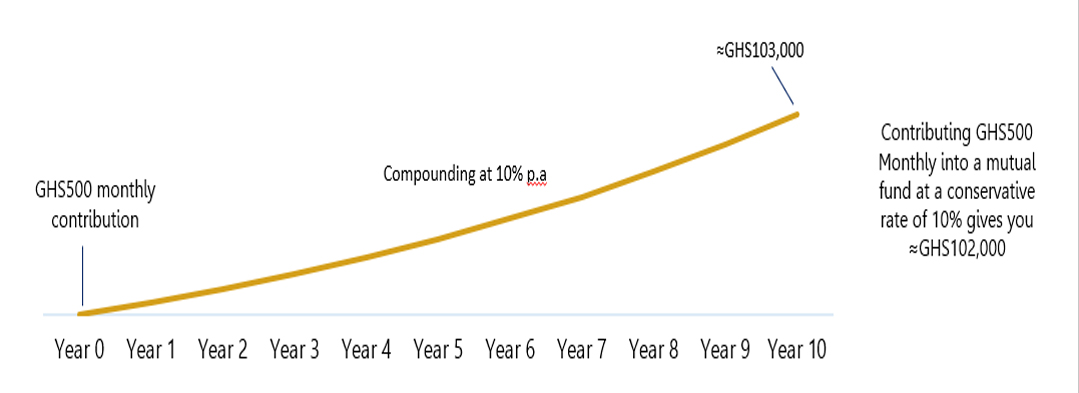
The real danger shows up when income stops, through job loss, a slow business, illness or even retirement. That is when the missing buffer becomes obvious. And the relatives who were once supported usually cannot help in return, not because they are ungrateful though they sometimes are, but because they are stretched just as thin.
Give With A Budget, Not A Blank Cheque
None of this argues against supporting family. It argues for treating family support the way any disciplined household treats a recurring liability: budgeted, bounded, and reviewed. Here are a few principles worth applying:
- Set a defined, budgeted amount for family support each month, the same way you would budget for any other recurring expense. Communicate boundaries clearly and early. Clear expectations reduce resentment on both sides.
- Protect retirement contributions, emergency funds, and investment commitments as non negotiables that come before discretionary family support, not after it.
- Separate a genuine emergency for a family member from a recurring lifestyle subsidy. One deserves a response. The other deserves a boundary.
- Teach dependents to build their own income streams instead of becoming their permanent solution. That is a better long-term gift than any single cash transfer.
The Legacy Worth Building
Black tax will likely remain a feature of Ghanaian family life for the foreseeable future. The financially sound response is not to withdraw from family obligation, but to bring the same discipline to it that any serious investor brings to every other financial decision.
The most durable form of generational wealth is not the ability to rescue every relative in every crisis. It is a family that eventually needs fewer rescues, because someone in an earlier generation chose to build capacity and capital rather than dependency.
——————————————————————————————————————————————————————————————————————————-
The information contained in this blog is being provided for educational purposes only and does not constitute a recommendation from any Bora Capital Advisors entity to the recipient. Bora Capital Advisors is not providing any financial, economic, legal, investment, accounting, or tax advice through this blog to its recipient.
This report reflects the views and opinions of Bora Capital Advisors Ltd, and is provided for information purposes only. Although the information provided in the market review and outlook section is, to the best of our knowledge and belief correct, Bora Capital Advisors Ltd, its directors, employees and related parties accept no liability or responsibility for any loss, damage, claim or expense suffered or incurred by any party as a result of reliance on the information provided and opinions expressed in this report, except as required by law. The portfolio performance data represented in this report represents past performance and does not guarantee future performance or results.