

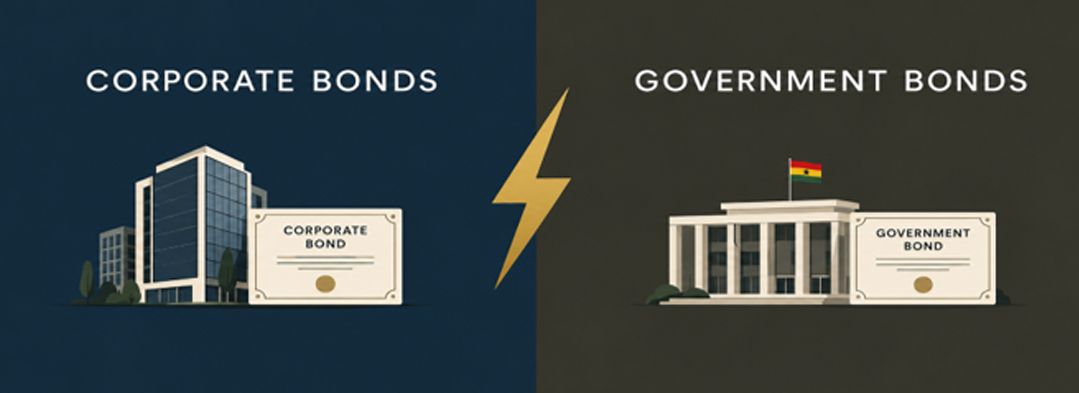
Corporate and government bonds trade side by side on the Ghana Fixed Income Market (GFIM). Both are listed on the same platform, cleared through the same Central Securities Depository, and quoted to the same investor base. But sharing a market does not mean sharing a risk profile. The risks behind a Government of Ghana (GoG) bond and the risks behind a corporate note from an issuer like Petrosol Platinum Energy PLC (Petrosol) or Bayport Savings and Loans rest on entirely different foundations, and that difference shapes how investors size and price each position.
The Basic Difference
A corporate bond is a loan to a company. A government bond is a loan to the government. Both promise to pay you interest and return your money at maturity. The difference is who is on the hook if things go wrong.
Why Corporate Paper Pays More
In August 2026, Petrosol issued a GH¢50 million bond on GFIM at a 16.25% coupon, maturing in 2030. Then in September, the government issued a similar 4-year bond at a 12.00% coupon. That gap, about 4.25 percentage points, is the market’s premium for holding corporate bonds. The coupon premium on corporate paper compensates for several risks that sovereign bonds do not carry in the same form. These include:
- Credit Risk: This is the main risk that distinguishes corporate bonds from government bonds. Credit risk is the risk that a borrower will not repay what they owe, so the lender loses money. Both bonds carry credit risk, but the risk is higher for corporate issuers. Petrosol is a single company. Its ability to repay depends on its operations, its profitability, cashflows and management decisions. The government’s ability to repay depends on the entire economy, tax and other revenue sources and access to domestic and external financing. Investors demand extra compensation for taking on that narrower, company specific risk from an issuer like Petrosol or other companies.
- Liquidity Risk: Liquidity risk is the risk that you cannot sell a bond quickly without taking a lower price because few buyers are active on the market. With corporate securities making up roughly one percent of traded volume, secondary market depth is thin. An investor who needs to sell a corporate bond before maturity may struggle to find a buyer and may have to accept a lower price, a risk that government bond, which is the dominant and most actively traded instrument on GFIM, does not carry to the same degree.
- Disclosure and Transparency: Government issuance is backed by public fiscal data, IMF programme reporting, and budget disclosures that are, continuously available to investors. Corporate issuers on GFIM vary widely in the depth and frequency of their financial disclosure, which makes credit assessment more labour intensive and less standardised across different names.
- Market Depth: The corporate segment of the market remains concentrated among a small set of repeat issuers, largely in savings and loans. There are only a few corporate bonds to choose from, so investors cannot diversify their investments. Investors therefore take on the credit risk of a few specific issuers, so a single default can weigh heavily on returns.
Government Bonds Are Not Risk Free Either
Based on the above, it is tempting to treat sovereign bonds as completely safe. Ghana’s own recent history says otherwise. The Domestic Debt Exchange Programme (DDEP) restructured government bonds, replacing existing securities with new ones carrying lower interest rates and longer maturities, so investors received less than they had originally expected. Government risk is lower than most corporate risks, but it is not zero!
Who Is Actually Issuing Corporate Bonds
The corporate side of GFIM is small and concentrated. Ghana Cocoa Board alone accounts for GH¢7.33 billion of the GH¢8.45 billion in outstanding corporate securities. Beyond COCOBOD, the remaining issuers are Letshego Ghana, Bayport Savings and Loans, Izwe Savings and Loans, Kasapreko Company, Petrosol Platinum Energy and Quantum Terminal Plc.
What This Means for an Investor
A higher coupon on a corporate bond is not free money. It is compensation for real risk that government paper does not carry in the same way. Before buying corporate debt, it is worth asking a few simple questions: How much debt does this company already have? Are its profits and cashflows stable and sufficient enough to repay the bond? What happens to bondholders if it cannot pay?
Government bonds carry default risk, tied to the government’s finances. Corporate bonds carry issuer risk, tied to one company’s finances, and therefore pay a premium for that risk. Same market, same basic structure, genuinely different risks sitting underneath the yield.