

Slow and Steady Wins The Race

For over a century, the most reliable path to building wealth in financial markets has not been speed, speculation, or brilliance, but discipline.

Investors who commit to making steady investment contributions, long-term planning, and disciplined strategies have generally achieved more reliable investment results than people who chase short-term trends. This philosophy was championed by John Bogle, who promoted inexpensive index fund investing. He also advocated for long term investing, no matter the fluctuations in the short term, rather than trying to beat the market. There were many people who made mockery of John Bogle when he established the Vanguard Group in 1975 and introduced the first index fund for regular investors. It was referred to as “Bogle’s Folly.” And why? Because Bogle made it his goal to meet the market, at a minimal cost, rather than to beat it. Nearly sixty years later, trillions of dollars have been invested in index funds, and his philosophy has aided millions of investors in accumulating long-term wealth. So, what exactly makes this approach so powerful? Why has it worked through some of the most turbulent financial periods in modern history? The answer is simple: compounding!

The Power of Compounding

At its core, long-term investing is about compounding. It is basically your money having babies, and those babies having more babies. Over time, that growth turns into a massive snowball. An example is the S&P 500, which has historically delivered average annual returns of roughly 9–10% over long periods, including reinvested dividends. While individual years may swing dramatically, decades of steady participation have rewarded patient investors. What makes this powerful is not dramatic spikes, but consistency. A modest investment, left to grow over decades, can multiply significantly. When combined with regular contributions, the effect becomes even more pronounced. Compounding does not demand brilliance; it requires patience.

Diversification

But growth alone is not enough; you also need to protect what you’re building. That’s where diversification comes in. While compounding drives long-term returns, diversification helps manage the risks that come with staying invested over time. By spreading investments across different asset classes and industries, investors reduce the impact of any single underperforming asset. In simple terms, you’re not putting all your eggs in one basket. This makes the overall portfolio more resilient, as different assets tend to respond differently to economic conditions.

Staying the Course Even in Crisis

Even with a well-diversified portfolio, the greatest challenge in investing often lies not in strategy but in behavior—behavioral biases. Patience becomes most difficult and most critical during periods of uncertainty. A recent Ghanaian example is the Domestic Debt Exchange Programme in 2022. The announcement sparked significant anxiety among bondholders, prompting many to exit positions at steep discounts to avoid potential losses. As the process progressed and clarity improved, conditions stabilized. Investors who stayed the course were generally better positioned than those who sold early and crystallized losses. The pattern is consistent: in periods of stress, fear drives premature decisions, while patience supports long-term value preservation.

The Risk of Chasing Trends

Short-term speculation can be tempting, but it often comes at a cost. In 2018, Ghana experienced the collapse of Menzgold Ghana Limited, which had attracted investors with promises of unusually high returns. Many concentrated their funds in the scheme, drawn by its apparent consistency. When operations were halted by the Securities and Exchange Commission Ghana, investors lost access to their funds, with those most exposed bearing the greatest losses. In contrast, diversified portfolios proved more resilient. Chasing “hot” opportunities may seem attractive, but diversification remains the more reliable safeguard.

Investing Is a Marathon, not a Sprint

The metaphor holds true: investing is a marathon. A sprinter might look impressive for the first hundred meters, but endurance is what wins a marathon race. Equity markets globally have endured numerous financial crises, recessions, and geopolitical tensions. Yet long-term trends have remained upward. It is not to say that markets are risk-free; they are not. The lesson is that time, diversification, and discipline reduce risk and enhance opportunity.

Successful investing is less about predicting the future and more about preparing for it. By focusing on consistency, embracing diversification, and maintaining discipline through market cycles, investors can harness the full power of long-term growth. For many, consulting an investment advisor adds another layer of structure, helping investors align investment decisions with long-term goals and risk tolerance, manage risks, and seize opportunities aligned with their goals.

——————————————————————————————————————————————————————————————————————————-

The information contained in this blog is being provided for educational purposes only and does not constitute a recommendation from any Bora Capital Advisors entity to the recipient. Bora Capital Advisors is not providing any financial, economic, legal, investment, accounting, or tax advice through this blog to its recipient.

This report reflects the views and opinions of Bora Capital Advisors Ltd, and is provided for information purposes only. Although the information provided in the market review and outlook section is, to the best of our knowledge and belief correct, Bora Capital Advisors Ltd, its directors, employees and related parties accept no liability or responsibility for any loss, damage, claim or expense suffered or incurred by any party as a result of reliance on the information provided and opinions expressed in this report, except as required by law. The portfolio performance data represented in this report represents past performance and does not guarantee future performance or results.

Lower Rates, Higher Stakes: Navigating Securities Markets in an Easing Cycle

As 2026 unfolds, the Ghanaian economy is showing clear signs of macroeconomic stabilization

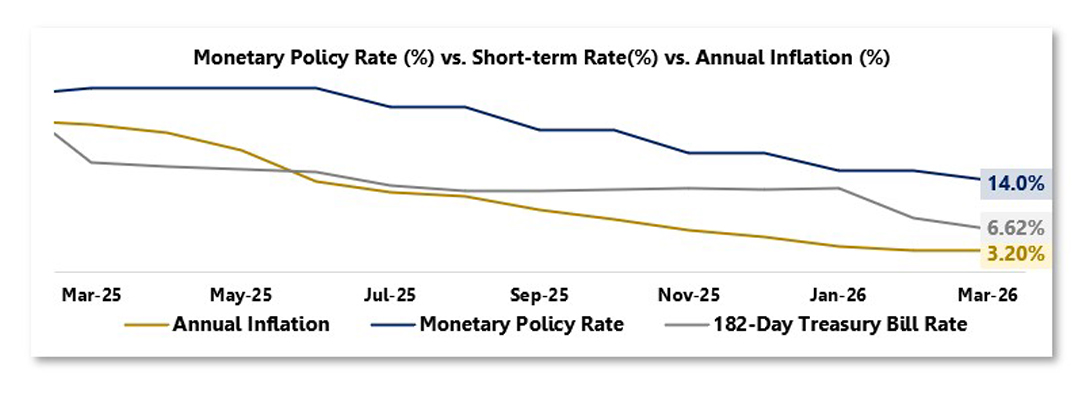
By February, inflation had dropped to 3.3%, extending a fourteen-month disinflation trend from 23.5% in January 2025. Over the same period, the Bank of Ghana reduced the Monetary Policy Rate (MPR) from 18.0% to 15.50%, before a further cut to 14.0% in March, bringing cumulative easing in 2026 alone to 400 basis points. This policy shift reflects improving macroeconomic fundamentals and declining price pressures.

While lower policy rates enhance liquidity and reduce borrowing costs across the economy, they also fundamentally reshape investment dynamics. As risk-free returns compress, investors are increasingly pushed along the risk curve in search of yield. In this environment, the opportunity set expands, but so do the stakes.

The Downward Trend in Treasury Bill Yields

The easing cycle is rapidly repricing Ghana’s Treasury bill market. At the start of 2025, short-term government securities delivered outsized returns, with the 182-day bill yielding above 28%. That window has now closed, and demand dynamics tell the story.

February auctions were heavily oversubscribed by 201.4%, but by March, oversubscription had dropped to just 14.0% as investors began rotating into more competitive opportunities. By the final auction of March 2026, the market turned undersubscribed by 20.14%: a clear signal that prevailing yields are no longer compelling.

For conservative investors, the implication is clear: the era of easy, high risk-free returns is ending. In this environment, attention is gradually shifting toward equities as a more viable source of return.

Equities as the New Return Engine

As fixed income yields compress, capital is rotating into equities in search of higher returns. As Treasury bill yields decline, equities become relatively more attractive, particularly dividend-paying and large-cap stocks capable of delivering positive real returns in a low-inflation environment.

However, this shift also brings greater exposure to market volatility, earnings uncertainty, and potential mispricing. The key question, then, is: How should investors position themselves to navigate this new landscape?

Strategic Positioning in a Lower Rate Environment

The changing rate landscape requires a more deliberate and diversified investment approach:

  1. Selective Equity Allocation

Equities present a compelling avenue for long-term wealth creation, but selectivity is critical. Investors should focus on fundamentally strong companies with strong earnings potential, sound balance sheets, and consistent dividend profiles.

  1. Diversification as a Core Strategy

Portfolio diversification is increasingly essential. Allocating across asset classes, sectors, and maturities can help mitigate downside risk while enhancing return potential. A clearly defined investment objective, risk tolerance, and time horizon remain central to effective portfolio construction.

  1. Exploring Alternative Fixed Income Options

Given a low-interest rate environment, it becomes crucial to explore alternative fixed income instruments such as corporate issuances, commercial paper, and fixed deposits to serve a similar purpose. These instruments can offer competitive yields, portfolio diversification, and improved risk-adjusted returns, although they may come with varying levels of credit and liquidity risk that require careful assessment.

Declining interest rates have reshaped Ghana’s securities market by compressing bond yields, driving capital into equities, and altering investor behavior. While the easing cycle has created opportunities for capital appreciation, it has also increased the consequences of poor allocation decisions.

In a lower-rate environment, the margin for error narrows. Investors who adopt disciplined, well-diversified strategies will be better positioned to preserve real returns and capitalize on opportunities within Ghana’s evolving financial landscape.


——————————————————————————————————————————————————————————————————————————-

The information contained in this blog is being provided for educational purposes only and does not constitute a recommendation from any Bora Capital Advisors entity to the recipient. Bora Capital Advisors is not providing any financial, economic, legal, investment, accounting, or tax advice through this blog to its recipient.

This report reflects the views and opinions of Bora Capital Advisors Ltd, and is provided for information purposes only. Although the information provided in the market review and outlook section is, to the best of our knowledge and belief correct, Bora Capital Advisors Ltd, its directors, employees and related parties accept no liability or responsibility for any loss, damage, claim or expense suffered or incurred by any party as a result of reliance on the information provided and opinions expressed in this report, except as required by law. The portfolio performance data represented in this report represents past performance and does not guarantee future performance or results.
Soft Live vs. Smart Life: The Wealth Conversation the Youth of Ghana are Not Having

For many young Ghanaians, the idea of a “soft life” has become the aspiration: comfort, enjoyment, and visible success. But the more difficult question is: are we building wealth or simply projecting it?

What Does “Soft Life” Really Mean?

Soft life, in simple terms, is about choosing ease over constant struggle. It reflects a desire for comfort, flexibility, and enjoyment without the level of stress that previous generations often endured while working relentlessly. In many ways, it’s understandable that young people want something different. However, in recent years, social media has reshaped the meaning of soft life, shifting the focus from financial freedom to visible consumption. The key difference is this: one is sustained by assets, while the other is funded by income.

Why is This a Problem?

The earning potential of young professionals has increased significantly compared to previous generations. However, many are still missing key elements of sustainable wealth building, including Equity investments, Fixed income instruments, Diversified Portfolios and Long-term planning.

The common pattern is to increase income and scale up spending alongside it, while becoming less consistent with savings and, in turn, delaying investments. In practice, lifestyle upgrades come first, and assets come later, if at all. Over time, investing becomes an afterthought, and for many people, “later” never actually arrives.

So, what’s the solution to the pitfalls of chasing a soft life? The answer lies in aiming for a smart life instead.

What Exactly is a Smart Life?

In short, it’s the less glamorous choice: the unpopular path. It looks like investing before upgrading your car, buying treasury bills before changing your gadgets to the latest release, building an emergency fund before planning the next trip or saying, “not yet” when everyone else is saying “why not?”.

However, it’s not about giving up everything or enduring constant hardship. It’s about finding balance, because a soft life without assets is ultimately unsustainable.


Ghana’s Reality and Why This Conversation Matters

Ghana’s economic environment is dynamic, shaped by currency fluctuations, inflation swings, and global market shifts, all of which affect purchasing power more than many young people realize. Simply holding cash is not enough. Building assets through structured investments and diversified portfolios provides real protection. While consumption is visible in real time, compounding, which truly changes lives, remains unseen. Social media amplifies displays of wealth but rarely shows investment statements, asset allocation choices, compound growth, or long-term planning.

So, What Does Balance Look Like?

Balance is not about rejecting a soft life or enjoyment entirely. It is about funding enjoyment intelligently and diligently. You can still relish Friday nights while consistently building your portfolio. A balanced young professional might invest 20–30% of income before lifestyle upgrades, diversify between fixed income and equities, hold assets in both cedis and foreign currency exposure and build medium-term and long-term strategies.

Ten years from now, today’s choices will have compounded. Will you be funding your lifestyle from your salary or from assets working for you? Soft life offers temporary comfort, but smart life provides sustainable freedom.

The Real Flex Is Not What You Post, But What You Own.


——————————————————————————————————————————————————————————————————————————-

The information contained in this blog is being provided for educational purposes only and does not constitute a recommendation from any Bora Capital Advisors entity to the recipient. Bora Capital Advisors is not providing any financial, economic, legal, investment, accounting, or tax advice through this blog to its recipient.

This report reflects the views and opinions of Bora Capital Advisors Ltd, and is provided for information purposes only. Although the information provided in the market review and outlook section is, to the best of our knowledge and belief correct, Bora Capital Advisors Ltd, its directors, employees and related parties accept no liability or responsibility for any loss, damage, claim or expense suffered or incurred by any party as a result of reliance on the information provided and opinions expressed in this report, except as required by law. The portfolio performance data represented in this report represents past performance and does not guarantee future performance or results.